

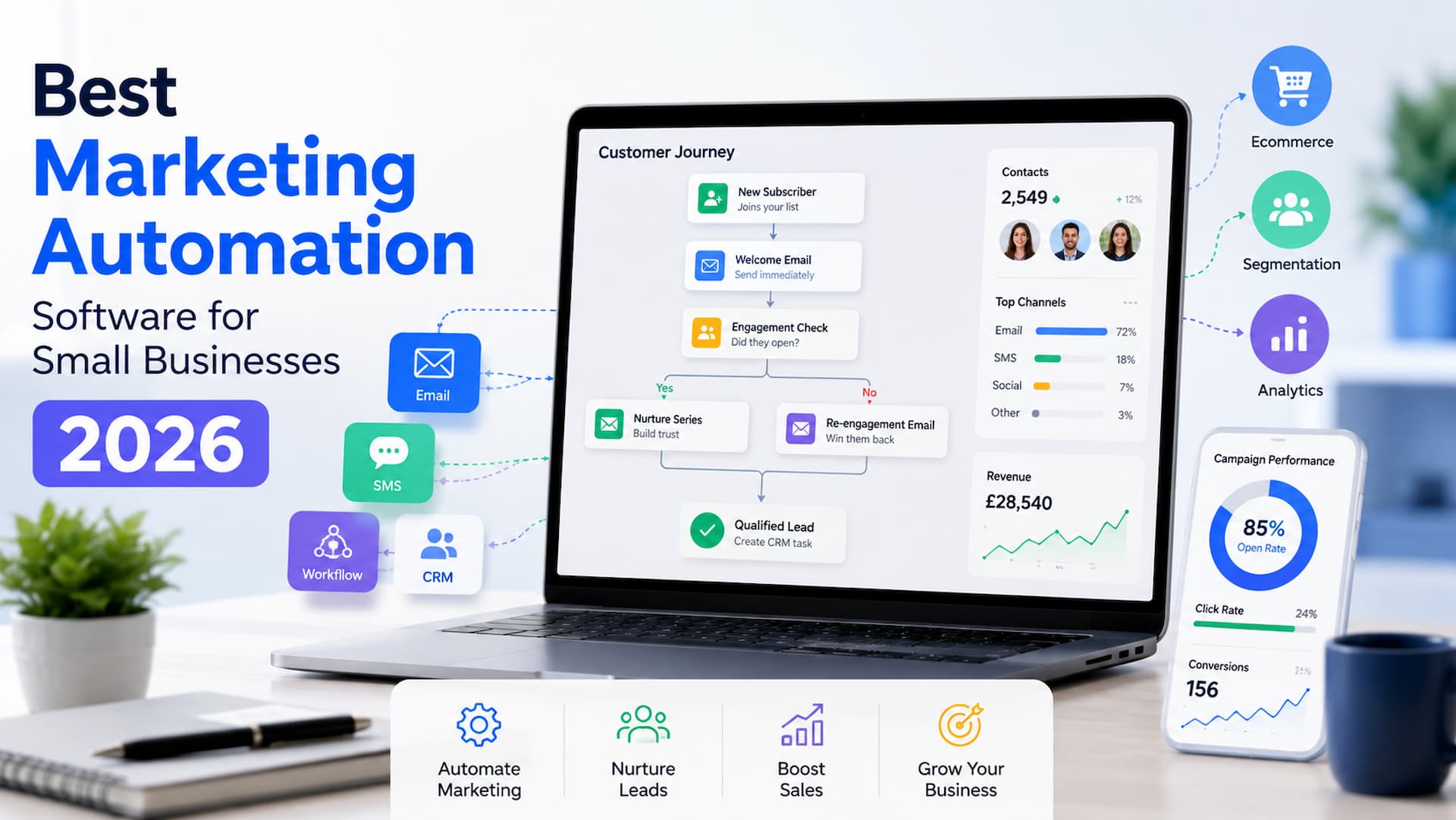
Marketing automation should save a small business time, not create another complicated system to manage.
For most SMEs, the goal is practical: automatically welcome new leads, follow up with prospects, recover abandoned baskets, segment customers, hand qualified leads to sales teams and understand which campaigns produce revenue. The best platform is not necessarily the one with the longest feature list. It is the one that provides the right combination of automation, affordability, usability and room to grow.
For this guide, we researched leading marketing automation platforms using current product pages, pricing information, documentation, integration directories and independent review platforms. Pricing and plan information was checked on 26 August 2026. We assessed each product specifically from the perspective of UK small businesses, start-ups, ecommerce companies, agencies and growing SMEs.
Our ranking is an editorial assessment based on the published methodology below. It is not based on undisclosed sponsorship, affiliate commissions or claimed hands-on testing.
1. Quick Answer
Best overall: Brevo
Best for advanced automation: ActiveCampaign
Best for CRM-led marketing: HubSpot
Best for ecommerce: Klaviyo
Best for beginners: GetResponse
Best budget choice: Brevo
Brevo is our best overall marketing automation software for small businesses in 2026 because it combines a generous free entry point, relatively affordable paid plans, email and SMS capabilities, CRM functions and increasingly capable workflow automation. ActiveCampaign is better when automation sophistication matters more than simplicity. HubSpot is the stronger choice when marketing must work closely with a structured CRM and sales process. Klaviyo stands out for online shops, while GetResponse offers an approachable all-in-one option for businesses primarily focused on email campaigns, landing pages and straightforward automation.
2. How We Chose the Best Marketing Automation Software
We screened established platforms including Brevo, ActiveCampaign, HubSpot, Klaviyo, GetResponse, Omnisend, Mailchimp, Zoho Marketing Automation and EngageBay.
Each finalist was evaluated using the same 100-point framework:
| Criterion | Weight |
|---|---|
| Marketing automation capabilities | 20% |
| Value for small businesses | 20% |
| Ease of use | 15% |
| Email and campaign capabilities | 10% |
| CRM and lead management | 10% |
| Integrations | 10% |
| AI and modern marketing features | 5% |
| Reporting and analytics | 5% |
| Customer support and trust signals | 5% |
We examined headline prices as well as contact limits, send allowances, automation restrictions, additional users, paid add-ons and the point at which a growing business may need to upgrade.
Review scores from G2 and Capterra were used as customer-sentiment indicators, not as substitutes for our ranking criteria. A product with thousands of favourable reviews did not automatically rank above a cheaper or more suitable small-business platform.
3. Brief Research Summary
Five platforms stood out after screening the broader market:
- Brevo offered the strongest overall balance of price, usability, multichannel marketing and small-business scalability.
- ActiveCampaign delivered the deepest general-purpose automation capabilities in the shortlist.
- HubSpot remained particularly strong where marketing, CRM and sales hand-offs need to operate within one ecosystem.
- Klaviyo was the strongest specialist for ecommerce behavioural data, segmentation and lifecycle marketing.
- GetResponse remained an accessible option for businesses wanting email, landing pages and automation without adopting a large CRM platform.
One notable near-miss was Omnisend. It remains highly competitive for ecommerce, with a free tier and strong customer ratings, but its narrower ecommerce positioning makes it less suitable for the full range of small businesses. Its 2026 pricing documentation also states that Standard-plan customers who subscribed after 4 May 2026 do not receive SMS access; SMS is available through Pro for those customers.
The broader market is moving towards AI-assisted workflow creation, customer-data activation and closer integration between marketing and CRM systems. ActiveCampaign introduced further AI orchestration capabilities in 2026, while Klaviyo expanded its Composer AI functionality and Omnisend introduced connections designed for AI-assisted marketing workflows.
4. Marketing Automation Software Comparison
| Rank | Platform | Best For | Starting Price* | Free Plan/Trial | Automation | CRM | AI Features | Key Limitation | Rating |
| 1 | Brevo | Best overall | Free; paid from $9/month | Free plan | Strong | Good | Yes | Advanced features require higher tiers | 87/100 |
| 2 | ActiveCampaign | Advanced automation | From $15/month | 14-day trial | Excellent | Good | Extensive | Learning curve; Starter automation limits | 86/100 |
| 3 | HubSpot | CRM-led growth | Free; Starter promotional pricing available | Free tools | Advanced on higher tiers | Excellent | Extensive | Professional tier is expensive | 82/100 |
| 4 | Klaviyo | Ecommerce | Free; paid pricing scales by active profiles/channels | Free plan | Excellent for ecommerce | B2C-focused | Extensive | Costs can rise with profile growth | 80/100 |
| 5 | GetResponse | Beginners | $19/month monthly | Free account + 14-day premium trial | Good | Basic | Yes | Starter automation is limited | 77/100 |
*Prices were checked on 26 August 2026 and are shown in the currency currently published by the relevant vendor sources. Taxes, regional pricing, promotions and annual-payment discounts may differ. Contact or profile growth can materially increase the actual cost.
5. The 5 Best Marketing Automation Platforms for Small Businesses in 2026
1. Brevo — Best Overall for Small Businesses
Quick Verdict
Brevo takes first place because it offers a particularly strong combination of low entry cost, email marketing, multichannel communication, automation and customer-management functions. Businesses can start small without immediately committing to an expensive CRM or enterprise marketing suite.
Why It Made the List
Brevo’s free plan allows up to 300 email sends per day, storage of up to 100,000 contacts, one user and automation for up to 2,000 contacts. Paid Starter begins at $9 per month, while Standard starts at $18 per month and removes the automation contact limit.
That pricing structure gives small businesses more room to experiment than many contact-priced competitors.
Key Features
Brevo covers email and SMS campaigns, segmentation, forms, transactional messaging, sales features, templates, landing pages on qualifying plans, automation, reporting and Aura AI.
Standard adds features including AI send-time optimisation, A/B testing and more advanced reporting. Higher tiers introduce functions such as AI segmentation, product recommendations and contact scoring.
Marketing Automation Capabilities
Businesses can build workflows for lead nurturing, welcome campaigns, behavioural follow-ups, customer re-engagement and ecommerce communication.
WooCommerce integration can synchronise customer, order and product information, while Salesforce connectivity supports lead and contact synchronisation and event-triggered workflows.
Pricing
- Free: $0
- Starter: from $9/month
- Standard: from $18/month
- Professional: from $499/month
Email-volume and contact allowances vary by tier. The jump to Professional is substantial, so growing teams should model future requirements rather than looking only at Starter pricing.
Ease of Use
Brevo is relatively approachable for smaller teams. Capterra showed a 4.6/5 overall rating from 3,512 reviews when checked, including 4.6 for ease of use. G2 listed Brevo Marketing Platform at 4.5/5 from 2,557 reviews. Customer feedback commonly highlights usability and the combination of email, SMS and automation, while some users report limitations when more sophisticated customisation is required.
Integrations
Verified connections include Shopify, WooCommerce, WordPress, PrestaShop, Salesforce, HubSpot, Pipedrive and Zoho, alongside Zapier and Make connectivity.
AI Features
Brevo currently includes Aura AI functions across its plans, with higher tiers adding capabilities such as AI segmentation and product recommendations. Standard includes AI-assisted send-time optimisation.
Pros
- Strong free plan and affordable entry pricing
- Email, SMS and automation in one environment
- Useful CRM and sales functions
- Large contact-storage allowance on the free plan
- Suitable for ecommerce and service businesses
Cons
- Some advanced functionality is restricted to expensive tiers
- Additional seats and certain features may add cost
- Advanced workflow users may prefer ActiveCampaign
Best For
Small businesses, local companies, start-ups and SMEs wanting broad marketing automation without enterprise-level pricing.
Avoid If
Choose another platform if highly sophisticated branching, predictive automation and complex lifecycle orchestration are your main priorities.
Editorial Score: 87/100
Score basis: Automation 17/20; value 19/20; ease 13/15; email 9/10; CRM 8/10; integrations 8/10; AI 4/5; reporting 4/5; support/trust 5/5.
2. ActiveCampaign — Best for Advanced Automation
Quick Verdict
ActiveCampaign is the stronger choice for businesses that have outgrown simple autoresponders and want detailed behavioural workflows without immediately moving to enterprise software.
Why It Made the List
Its automation system supports conditional logic, connected automations and a large collection of automation recipes. ActiveCampaign documents more than 900 automation recipes, making it particularly useful for teams that want sophisticated lifecycle workflows.
Key Features
Capabilities include email campaigns, website tracking, forms, segmentation, automation, landing pages on qualifying plans, ecommerce connections, predictive sending, event tracking and revenue attribution.
Marketing Automation Capabilities
Practical workflows can cover lead nurturing, behavioural follow-ups, customer onboarding, sales notifications, abandoned baskets and re-engagement.
One important limitation is that Starter restricts automations to five actions per automation. More serious automation programmes will usually require Plus or Professional.
Pricing
ActiveCampaign currently advertises marketing automation from $15 per month for fewer than 1,000 contacts. It offers a 14-day trial rather than a permanent free plan. Pricing scales with contacts and the feature tier selected.
Ease of Use
The automation depth inevitably adds complexity. G2 showed 4.4/5 from 14,677 reviews, while Capterra listed 4.6/5 from 2,568 reviews and 4.2 for ease of use. Review patterns suggest strong satisfaction with automation and personalisation, but a steeper learning curve than simpler email-focused products.
Integrations
Verified integrations include Shopify, WooCommerce, Stripe, PayPal, BigCommerce, Google Ads, Facebook and Zapier. Salesforce connectivity is available under specific higher-tier requirements.
AI Features
ActiveCampaign has expanded AI functionality substantially, including AI-assisted campaign creation, automation suggestions, content generation, predictive sending and AI Prompt Blocks capable of processing information inside workflows.
Pros
- Excellent workflow depth
- Strong behavioural segmentation
- Large automation recipe library
- Broad integration ecosystem
- Rapidly developing AI capabilities
Cons
- No permanent free plan
- Starter’s five-action automation limit is restrictive
- More complex than Brevo or GetResponse for beginners
Best For
Agencies, SaaS companies and growing SMEs that need sophisticated marketing journeys.
Avoid If
Your requirements are limited to newsletters, basic follow-ups and occasional campaigns.
Editorial Score: 86/100
3. HubSpot — Best for CRM-Led Marketing and Sales Alignment
Quick Verdict
HubSpot is difficult to beat when CRM, lead management, sales processes and marketing automation need to share the same underlying customer record. Its main disadvantage for a small business is cost once advanced Marketing Hub automation becomes necessary.
Why It Made the List
HubSpot combines forms, landing pages, email, contact management, workflows, lead scoring, reporting and a mature CRM ecosystem. Its workflow tools support automated lead routing, scoring and customer journeys.
Marketing Automation Capabilities
Teams can automate lead capture, nurture programmes, sales notifications, lifecycle-stage changes, task creation, lead scoring and campaign follow-ups.
The distinction between HubSpot’s accessible free/Starter tools and Professional automation is important: businesses needing advanced workflows should evaluate the Professional economics before migrating substantial data.
Pricing
HubSpot has free tools for up to two users. At research time, its pricing page advertised Starter from $7 per seat/month for eligible new customers, against a $20 reference price.
Marketing Hub Professional starts at approximately $800 per month on the displayed annual terms, includes 2,000 marketing contacts and requires a $3,000 one-time Professional onboarding fee. Promotional prices should not be treated as normal long-term costs.
Ease of Use and Integrations
HubSpot benefits from a large app ecosystem. Verified marketplace connections include WordPress, Zapier, Meta Ads, Shopify, WooCommerce and Salesforce.
G2 showed Marketing Hub at roughly 4.4/5 from 14,600+ reviews, while Capterra reported 4.5/5 from 6,251 reviews. Review sentiment frequently praises its unified platform while identifying cost escalation as a concern.
AI Features
HubSpot now incorporates AI-assisted content creation and workflow functionality across its marketing platform, alongside its CRM and campaign tools.
Pros
- Excellent CRM and marketing alignment
- Strong lead-management functionality
- Extensive app marketplace
- Useful free tools
- Suitable for structured B2B growth
Cons
- Advanced marketing automation is expensive
- Professional onboarding adds significant upfront cost
- Small teams may pay for more functionality than they need
Best For
B2B SMEs with dedicated sales and marketing processes.
Avoid If
Your monthly automation budget is modest or you mainly need email and straightforward customer journeys.
Editorial Score: 82/100
4. Klaviyo — Best for Ecommerce Marketing Automation
Quick Verdict
For ecommerce businesses, Klaviyo provides one of the strongest combinations of behavioural data, segmentation, messaging and automated customer journeys. Its economics become less attractive when active-profile counts grow quickly.
Why It Made the List
Klaviyo is built around customer and commerce data rather than conventional newsletter lists. Its integrations can synchronise order, catalogue and customer information from major ecommerce platforms in near real time.
Key Features and Automation
Klaviyo supports email, SMS, mobile push, segmentation, automated flows, reporting, predictive functions and ecommerce lifecycle campaigns.
Typical applications include abandoned baskets, post-purchase campaigns, replenishment reminders, VIP segmentation, win-back programmes and product recommendations.
Pricing
The free plan supports up to 250 profiles and 500 monthly emails, with a small mobile-message allowance and built-in reporting.
Paid pricing varies according to the number of active profiles and channels selected. Klaviyo’s documentation states that plans must accommodate the account’s active-profile count, which can make database hygiene financially important. Marketing Analytics is a separate paid product starting at $100 per month for up to 13,500 active profiles.
Integrations
Klaviyo supports major ecommerce platforms including Shopify, WooCommerce, BigCommerce and Adobe Commerce, together with advertising and commerce integrations. The company reports more than 350 pre-built integrations.
AI Features
Klaviyo expanded its Composer capabilities in 2026. Composer can help build campaign and flow components from natural-language instructions, while Klaviyo’s broader AI stack includes predictive analytics, content support and personalisation functions.
Trust Signals
G2 reported 4.6/5 from 1,345 reviews, while Capterra listed approximately 4.6/5 from 535 reviews. Users frequently value its segmentation and ecommerce integrations; cost growth and the learning curve appear among recurring concerns.
Pros
- Excellent ecommerce behavioural segmentation
- Strong lifecycle automation
- Deep commerce-platform integrations
- Good predictive and AI functionality
- Useful revenue-oriented reporting
Cons
- Profile-based pricing can rise quickly
- Less suitable for traditional B2B sales processes
- Some analytics functionality carries additional cost
Best For
Shopify, WooCommerce and other ecommerce businesses with enough customer data to use behavioural personalisation effectively.
Avoid If
You run a service-based or B2B company that needs a conventional sales CRM.
Editorial Score: 80/100
5. GetResponse — Best for Beginners and Straightforward Campaign Automation
Quick Verdict
GetResponse is a practical choice for smaller companies that want email marketing, landing pages, funnels and basic automation in one package without adopting a heavyweight CRM system.
Why It Made the List
It combines newsletter creation, landing pages, forms, automation and AI-assisted content features with predictable entry pricing.
Marketing Automation Capabilities
Starter allows one custom automation workflow with up to six elements. Marketer removes that restriction and adds more sophisticated ecommerce automation, including abandoned-basket functionality and advanced segmentation.
Pricing
For up to 1,000 subscribers, Starter begins at $19 per month when paid monthly, or approximately $15.58 per month on annual billing. Marketer begins at $59 monthly at the entry list size.
GetResponse maintains a free account for up to 500 contacts and 2,500 newsletter sends per month, while new accounts receive premium capabilities for the first 14 days.
Integrations and AI
Verified integrations include WordPress, Shopify, WooCommerce, Magento and Google Analytics. Its AI assistant can help create and revise marketing copy used in newsletters, autoresponders and automation messages.
Trust Signals
G2 listed GetResponse at 4.3/5 from 1,119 reviews, while Capterra showed 4.2/5 from 524 reviews. Users commonly praise its consolidated email-marketing toolkit, although richer automation requires higher plans.
Pros
- Beginner-friendly campaign toolkit
- Free account available
- Landing pages and email in one product
- Unlimited email sends on paid entry plans
- Useful ecommerce integrations
Cons
- Starter automation is deliberately limited
- CRM capabilities are weaker than HubSpot
- Advanced segmentation and ecommerce functions require upgrades
Best For
Small businesses and marketing beginners primarily focused on email campaigns, landing pages and manageable workflows.
Avoid If
You need complex sales automation, sophisticated CRM processes or deeply branched customer journeys.
Editorial Score: 77/100
6. Which Marketing Automation Platform Should You Choose?
Choose Brevo if you want the best overall balance. It offers enough automation for most small companies without forcing them immediately into expensive plans.
Choose ActiveCampaign if advanced automation is central to your marketing strategy. Its workflow depth and behavioural tools justify the additional complexity.
Choose HubSpot if marketing and sales teams need one CRM-led operating system. The platform becomes particularly attractive once lead routing, lifecycle management and pipeline visibility matter more than low entry pricing.
Choose Klaviyo if you operate an ecommerce shop. Its commerce data, behavioural segmentation and lifecycle workflows give it a clear specialist advantage.
Choose GetResponse if ease of use matters most. It is particularly suitable for smaller teams progressing from newsletters into basic marketing automation.
7. Marketing Automation Software by Business Type
| Business Type | Recommended Platform | Why |
| Start-up | GetResponse | Straightforward email, landing pages and free entry option |
| Small ecommerce business | Klaviyo | Deep ecommerce data and lifecycle automation |
| B2B company | HubSpot | Strong CRM, lead management and sales hand-offs |
| Local business | Brevo | Affordable email, SMS and manageable workflows |
| Marketing agency | ActiveCampaign | Flexible automation and broad integrations |
| Small SaaS company | ActiveCampaign | Behaviour-triggered journeys and lifecycle automation |
| Growing SME | Brevo | Strong balance between cost, capability and scalability |
8. Free vs Paid Marketing Automation Software
Free marketing automation can be sufficient when a business has a small contact database, sends relatively few campaigns and only needs simple welcome messages or follow-ups.
The free tiers become restrictive when the business needs several users, unrestricted automation, advanced segmentation, higher send volumes, detailed reporting, lead scoring or multichannel campaigns.
The limitation differs by provider. Brevo’s free account restricts daily sends and automation volume; Klaviyo limits profiles and monthly sends; GetResponse caps contacts and newsletters. ActiveCampaign provides a time-limited trial rather than a permanent free tier.
Pay because a feature solves a recurring business requirement—not simply because the vendor labels the tier “Professional”.
9. What Marketing Automation Software Should Cost
Marketing automation pricing generally follows four models:
- Contact-based pricing — costs increase as the subscriber or profile database grows.
- Email-volume pricing — plans include a defined number of monthly or daily sends.
- Feature tiers — sophisticated workflows, reporting, AI or segmentation require higher plans.
- User or add-on charges — extra seats, SMS, analytics and CRM functions may incur separate fees.
For a small database, entry-level software can cost less than £20 equivalent per month. Advanced platforms can move into hundreds of pounds monthly, while CRM-led suites such as HubSpot can reach considerably higher levels once Professional features and onboarding are required.
The most important calculation is future cost at your expected contact count, not the cheapest advertised starting price.
10. Marketing Automation Trends to Watch in 2026
AI Is Moving Inside Workflows
AI marketing functionality is shifting beyond isolated email-copy generators. ActiveCampaign now places AI inside campaign and automation processes, while Klaviyo’s Composer can help marketers construct campaign components and flows.
Marketing and CRM Are Converging
Marketing automation is increasingly connected to first-party customer records, behavioural data and sales activity. HubSpot represents the traditional B2B CRM-led model, while Klaviyo is pushing a commerce-centred B2C customer-data model.
Multichannel Automation Is Becoming Standard
Email remains central, but SMS, push notifications, WhatsApp and advertising audiences are increasingly incorporated into automated customer journeys.
Pricing Governance Matters More
Contact-based and active-profile pricing means inactive or poorly maintained customer databases can create unnecessary cost. Klaviyo and Omnisend both document billing mechanisms linked to profile or billable-contact counts.
AI Assistance Still Requires Human Oversight
Generative features can reduce repetitive campaign work, but automated content, targeting and recommendations still require review for accuracy, tone, customer experience and regulatory compliance.
11. Strengths, Weaknesses and Market Positioning
| Market Position | Strongest Platform | Editorial View |
| Price/value | Brevo | Broad feature set at accessible entry levels |
| Ease for beginners | GetResponse | Lower operational complexity |
| Advanced automation | ActiveCampaign | Strongest workflow depth |
| Ecommerce | Klaviyo | Specialist customer-data and lifecycle approach |
| CRM integration | HubSpot | Strongest unified sales and marketing proposition |
| Multichannel SME marketing | Brevo | Email, SMS and CRM in one affordable environment |
| Potential cost escalation | HubSpot/Klaviyo | Professional tiers or profile growth can materially raise costs |
| Largest capability gap | GetResponse CRM | Strong campaign toolkit but less suitable for complex sales pipelines |
These positions are editorial interpretations of current products and pricing rather than vendor-supplied rankings.
12. Positioning Gaps and Opportunities
Despite the maturity of the category, several opportunities remain.
Affordable advanced automation: Businesses frequently have to choose between inexpensive but limited workflows and sophisticated platforms that become costly as requirements increase.
Predictable pricing: Clearer projections showing what a platform will cost at 1,000, 10,000 and 50,000 contacts would make comparisons easier.
Better small-business onboarding: Powerful automation is wasted if a small team cannot create its first useful workflow quickly.
Practical AI rather than AI labels: Vendors can differentiate by demonstrating hours saved, campaigns created or workflow decisions simplified rather than merely adding generative writing tools.
Simpler CRM-marketing integration: There remains room between lightweight email contact management and expensive enterprise CRM suites.
Clearer reporting: Small companies need revenue, lead and conversion answers—not dozens of dashboards requiring an analyst to interpret them.
13. Recommended Messaging Angles
Headline Ideas
- Powerful Marketing Automation Without Enterprise Complexity
- Do More Marketing With a Smaller Team
- Turn Repetitive Marketing Tasks Into Automated Workflows
- Simple Marketing Automation Built for Growing Businesses
- Marketing Automation That Scales at Your Pace
USP Ideas
- Transparent pricing that remains understandable as contacts grow.
- Advanced workflows without an enterprise-level learning curve.
- Email, CRM and customer journeys managed from one simple workspace.
- AI assistance focused on reducing repetitive campaign work.
- Small-business onboarding built around real workflows rather than product tours.
CTA Ideas
- Build Your First Automation
- Start Your Free Trial
- Compare Plans
- See How the Workflows Operate
- Find the Right Plan for Your Business
14. Frequently Asked Questions
What is the best marketing automation software for a small business?
Brevo is our best overall choice for 2026 because its combination of accessible pricing, automation, email, SMS, CRM functions and scalability suits a broad range of small businesses.
What is the easiest marketing automation software to use?
GetResponse is a strong option for beginners who mainly need email campaigns, landing pages and straightforward workflows. Brevo is another accessible option with broader multichannel capabilities.
Is marketing automation worth it for small businesses?
It can be when it replaces repetitive manual work. Welcome emails, lead nurturing, basket recovery, re-engagement and sales notifications are good examples of repeatable activities that can justify automation.
What is the cheapest marketing automation platform?
Among our five finalists, Brevo has the lowest verified paid starting price at $9 per month, and it offers a permanent free tier. Real cost depends on send volume, contacts and required features.
Can I use marketing automation without a CRM?
Yes. Businesses can automate email and customer journeys without running a full sales CRM. A CRM becomes more useful when lead ownership, pipelines, sales follow-ups and marketing-to-sales hand-offs need structured management.
Which marketing automation software is best for ecommerce?
Klaviyo is our ecommerce winner because of its behavioural segmentation, commerce integrations and lifecycle automation. Omnisend is another strong ecommerce-specific alternative.
Does marketing automation software use AI?
Yes. Current platforms use AI for areas including campaign creation, content generation, segmentation, predictive sending, workflow assistance and recommendations. The sophistication varies substantially by platform and plan.
How much should a small business spend on marketing automation?
There is no universal budget. Very small businesses can start free or below roughly £20 equivalent per month, while advanced CRM and workflow requirements can push costs into hundreds of pounds monthly. Budget against expected contacts, users and required functionality over the next 12–24 months.
15. Final Verdict
For most small businesses, Brevo is the strongest overall marketing automation platform in 2026. Its advantage is not that it dominates every individual category. ActiveCampaign has deeper workflows, HubSpot has a stronger CRM proposition and Klaviyo is better suited to sophisticated ecommerce lifecycle marketing. Brevo wins because it provides the most convincing combination of affordability, practical automation and usability.
Our final recommendations are:
- Best overall: Brevo
- Best budget choice: Brevo
- Best ecommerce platform: Klaviyo
- Best advanced automation: ActiveCampaign
- Best for beginners: GetResponse
- Best CRM-led option: HubSpot
A young business running a few basic campaigns should avoid buying software for requirements it may never use. A growing company with complex customer journeys should avoid choosing solely on introductory price.
Match the system to the sophistication of your marketing programme—not the size of the vendor’s feature list.
Editorial Disclaimer
This article is provided for informational and comparison purposes only. Rankings, scores and recommendations reflect our independent editorial assessment based on publicly available information, including official product documentation, pricing pages and third-party review platforms.
We do not claim to have personally tested every platform unless explicitly stated. Software features, pricing, plan limits, integrations and availability may change over time or vary by country and subscription level. Readers should verify current information directly with the software provider before making a purchasing decision.
Any commercial, affiliate or sponsored relationship that could influence or appear to influence editorial judgement should be clearly disclosed. Such relationships do not determine the rankings presented in this guide.
